Above Ground Pool Liners: Understanding the Different Types

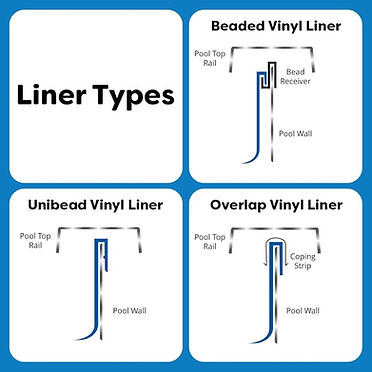
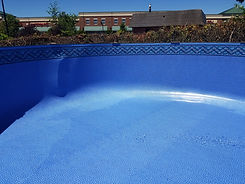
I like to explain these differences to my customers because the liner you choose can affect how your pool looks, how easy it is to install, and how easy it will be to replace in the future.
In this guide, I’ll walk you through the most common types of above-ground pool liners and share some of my real-world experience installing them.
Overlap Pool Liners
The first type of liner commonly used in above-ground pools was the overlap liner.
With this style, the liner is pulled over the top of the pool wall and hangs slightly down the outside of the wall. The top rails are then installed to hold everything in place. Because the liner overlaps the pool wall, it became known as an overlap liner.
Overlap liners are still widely used today and are usually the most affordable liner option available. Another advantage is that many overlap liners can fit multiple pool wall heights, which makes them convenient in many situations.
However, there are a few downsides. Many homeowners don’t like the appearance of the liner hanging down on the outside of the pool wall. If the liner has a tile pattern or decorative design inside the pool, it can also be harder to make that pattern sit perfectly level.
Installation can also require a bit more patience. The liner needs to be pulled evenly around the entire pool wall. If it’s not installed carefully, the pattern inside the pool may appear crooked. In the real world, many homeowners build decks around the pool, which limits space. Pulling a liner over the wall in these situations can be tricky, and it’s easy to accidentally nick or tear the liner. Some pool models have uprights with sharp edges that can also damage the vinyl.
In many cases, overlap liners are made with thinner vinyl material, which is another reason they tend to be lower-cost. For larger pools with decks around them, overlap liners can be complicated to install, and installers often charge more because of the extra labor. You’re also putting a thinner, cheaper liner into a pool that may see heavy use — in my opinion, not the ideal choice.
Beaded Pool Liners
The next liner system that became popular during the early years of my career was the beaded liner system.
Beaded liners were originally common in inground pools, where the liner snaps into a track around the pool. Manufacturers later applied the same concept to above-ground pools by creating a sectional track system that installs on top of the pool wall.
This track is usually made from plastic or metal and allows the liner to snap securely into place. The goal was to create a cleaner, more finished look for above-ground pools.
Instead of hanging over the pool wall like an overlap liner, a beaded liner has a thick bead along the top edge that snaps into the track. This keeps the entire liner inside the pool, so nothing is visible from the outside.
Many homeowners prefer beaded liners because they give the pool a more finished and professional appearance, and they can make it easier to keep the liner pattern level during installation.
However, over the years I’ve seen some real-world problems with beaded liners:
Unlike inground pools, above-ground liners are not always made to fit perfectly. Sometimes the liner goes in a little tight, and sometimes a little loose. With overlap or J-hook liners, installers have more room to adjust. Beaded liners leave less wiggle room.
A common call I get is about liners popping out of the track. This can happen as the track ages or bends slightly. Getting the liner back into the track, especially when the pool is full, can be extremely difficult.
Many beaded systems were marketed as “no need to take the pool apart,” which led homeowners to build decks over the rails. In reality, this makes liner replacement much harder due to limited working space.
On oval pools, the sidewalls can push outward as the pool settles, which affects track and rail spacing, making liner installation trickier.
Warped tracks can cause the liner to keep popping out, and sometimes it’s hard to tell that the track itself is the problem. Finding replacement track pieces, especially metal ones, can also be challenging.
Some sectional tracks allow water to creep between pieces, which can eventually damage the pool wall. Overlap and J-hook liners generally do a better job of keeping water out.
J-Hook Pool Liners (Now Often Called Unibead)
The next liner style that came along was the J-hook liner.
A J-hook liner gets its name from the shape of the top edge of the liner. The vinyl is formed into a hook shape that hangs directly over the top of the pool wall, almost like a “J.” Because of this design, the liner can hang on the wall without needing coping strips, unlike overlap liners.
J-hook liners give the pool a cleaner, more finished look, and they stay completely inside the pool. They are also usually easier to install, since you simply hook the liner onto the top of the pool wall before installing the top rails.
Over time, manufacturers began combining the J-hook design with the beaded liner system, creating a liner that could work in either type of pool setup.
Today, these liners are commonly called Unibead liners. They can be installed as a J-hook liner, or the hook portion can be removed so the liner snaps into a beaded track.
The main reason manufacturers did this was to simplify inventory. Instead of making separate liners for J-hook pools and beaded pools, they could produce one liner that works for both systems. For installers and homeowners, this design adds flexibility, because the same liner can be used in different types of above-ground pool installations.
Why I Think Unibead Liners Are the Best
In my experience, Unibead liners are the best liners available today for above-ground pools. They are typically premium-quality liners that are easier to install and less prone to problems.
One of the biggest advantages is that they protect the inside pool wall, because the liner hooks from the top of the pool — unlike some beaded liners.
The main thing to know with this type of liner is your pool’s wall height. On the market today, there are three standard wall heights:
48 inches (first height)
52 inches (standard)
54 inches (premium)
If you don’t know your pool’s height, don’t worry — it’s easy to measure:
From the outside: Use a small scoop or trowel to remove a bit of dirt next to the wall until you can see the bottom track. Measure from the bottom of the track up to the top track — that’s your wall height.
From the inside: If the pool is empty, measure from the floor of the pool to the top of the track where the wall locks in place.
Once you know the height, you’ll know exactly which Unibead liner fits your pool.
Quick tip: If you see the liner hanging on the outside of the pool wall, that means you have an overlap liner. If it fits inside a track, it’s either a beaded liner or a Unibead liner — the good news is that a Unibead liner works for both.
If you’re unsure about the pool size, measure from wall to inside wall in a cross-shape pattern and review the measurements with your installer. Many homeowners even text me a picture of their pool, and after working in the industry for so long, I can usually recognize the model, where it came from, and which liner sizes are compatible. This makes it easy for people who bought a house with a pool to know what they have and what replacement liners are available.


Comments